

1910 — Brooklyn — Wikipedia — Pinsetters
Before Gottfried Schmidt invented his mechanical device in 1936, the work of setting bowling pins was done by pinsetters. Young boys would stay up past midnight to repeatedly arrange knocked down pins.
There were many manual and tedious jobs like this in the early 20th century. Jobs that would entail doing the same task over and over again in a predictable environment. Due to technological advancements, these jobs have been automated away and few would challenge that our society as a whole is better off as a result.
Several years ago I wrote about how everything that can be automated will be automated. I was referring to technological automation and its impacts on the global economy.
Fast forward to today and that statement is truer now than ever before.
According to the KPMG:
45% of activities individuals currently perform in the workplace can be automated using already demonstrated technologies.
60.5% compound annual growth in robotics automation market forecast by 2017–20
More than 55% of global corporations are currently exploring new automation opportunities

Automation via Flickr
Over the past decade, we have experienced the impact of automation everywhere from the grocery store checkout line to the autoplay of algorithmic suggested shows on Netflix. Additionally, automation has taken over our workplaces with the immense growth in SaaS products that have automated many aspects of Finance, HR, Sales, and Marketing functions.
I am more convinced than ever that not only will everything that can be automated eventually be automated but that it will continue to accelerate and compound its growth. The current incentive structure compels companies to invest heavily in automation as it reduces their overhead costs and allows them to grow faster. The future belongs to those that build the robots and the race is heating up globally.
As someone who thinks quite a bit about the efficient allocation of human capital, I have been doing some research and analysis on the best points of leverage for human capital in this era of rapid automation.
What will be the impact of this automation on the individuals and their roles within companies and organizations moving forward?
For simplicity, I have divided the individuals that work in a company into three main segments → Executives/C-Suite, Middle Managers, and Individual Contributors.
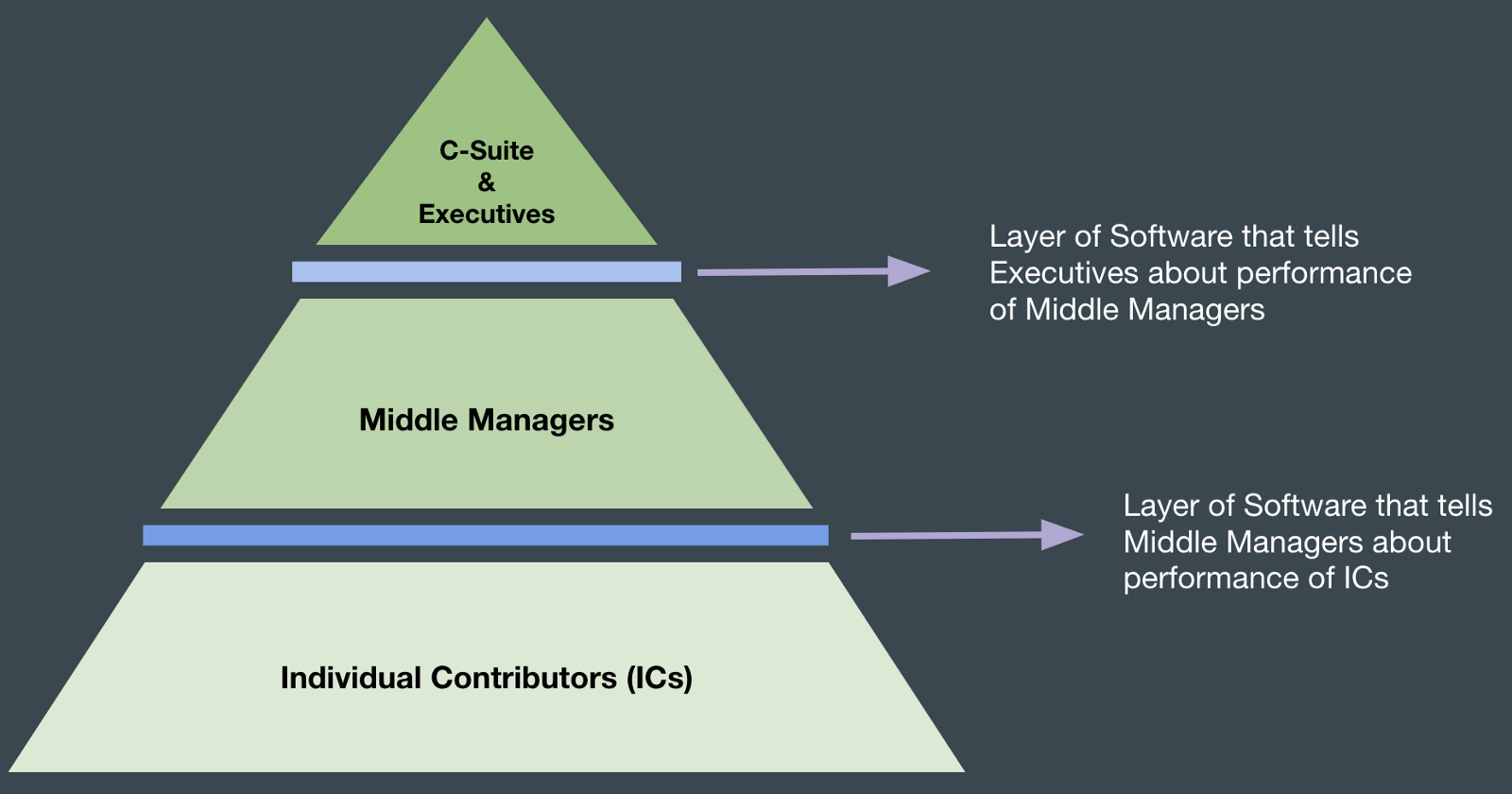
Simplified hierarchy of current companies
Individual Contributors (ICs) are the people in a company who do not manage anybody. They are the front lines of their own functions and business units. From the standpoint of automation, the IC’s job is actually the hardest to automate over the long run.
A company takes raw materials from a highly complex and unstructured world and transforms it into a finished product to sell in the market. Although some tech companies have varied business models, at their core they are all fundamentally about producing something that then gets consumed by other individuals or other businesses.
ICs are at the forefront of engaging with a complex world to extract and decompose raw materials/information into digestible pieces such that the rest of the org can digest and spin out a finished product. Think about any customer support or sales representative. This job is incredibly hard to automate because people hate talking to auto-dialers and consumers usually have a long-tail of nuanced challenges and emotions that need to be managed.
The Achilles heel of automation is large, unstructured, and messy datasets full of nuance.
As you move up from ICs to Middle Managers, it gets a lot easier. ICs have done most of the hard work of ingesting, filtering, and processing complexity. Furthermore, there are lots of software tools that can track every behavior of ICs. Today in Marketing, Sales, Recruiting and other functions almost every activity of an individual can be tracked. Email activity, phone calls, and even in-person conversations can all be tracked and analyzed for accuracy, punctuality, sentiment and a myriad of other variables. We are rapidly approaching a world where there will be statistics for all ICs in their given functions much like statistics for baseball or football players.
Middle Managers will have more data than ever to make decisions. Therefore, the value of a Manager will shift from the ability to merely gather data to actually analyzing and processing data in order to make key decisions. And the decision could be either gather more/different data optimized for a different set of variables (essentially replacing the data) or retool/replace the IC. At some point, this will be a judgment call and the system will be designed such that those with the best judgment over a repetitive number of decision points rise up in the Org. Because every decision a Middle Manager will make is also tracked, it will be easier than ever to distinguish good managers from the bad ones.
Given the nature of automation and how software will just eat away at many of the functions of managers today, organizations will be much flatter. Companies that have many layers of management will be able to use software to replace the vast majority of them.
Automation has the potential to obfuscate the middle manager.
A recent survey of 845 senior execs globally across several industries demonstrated that 72 percent believed that “increasing use of AI and robotics will dramatically reduce the number of middle managers in most organizations over the next decade.”
If you extrapolate the model where software automates most of the data gathering & performance analysis of a manager, you could easily imagine a world where your manager is the layer of software between you and the C-Suite/Executive layer in a company.
Maybe Alexa or Siri can analyze all the data in our email, calls, and CRM to tell us exactly what we need to do better and what we have been doing well on so far?
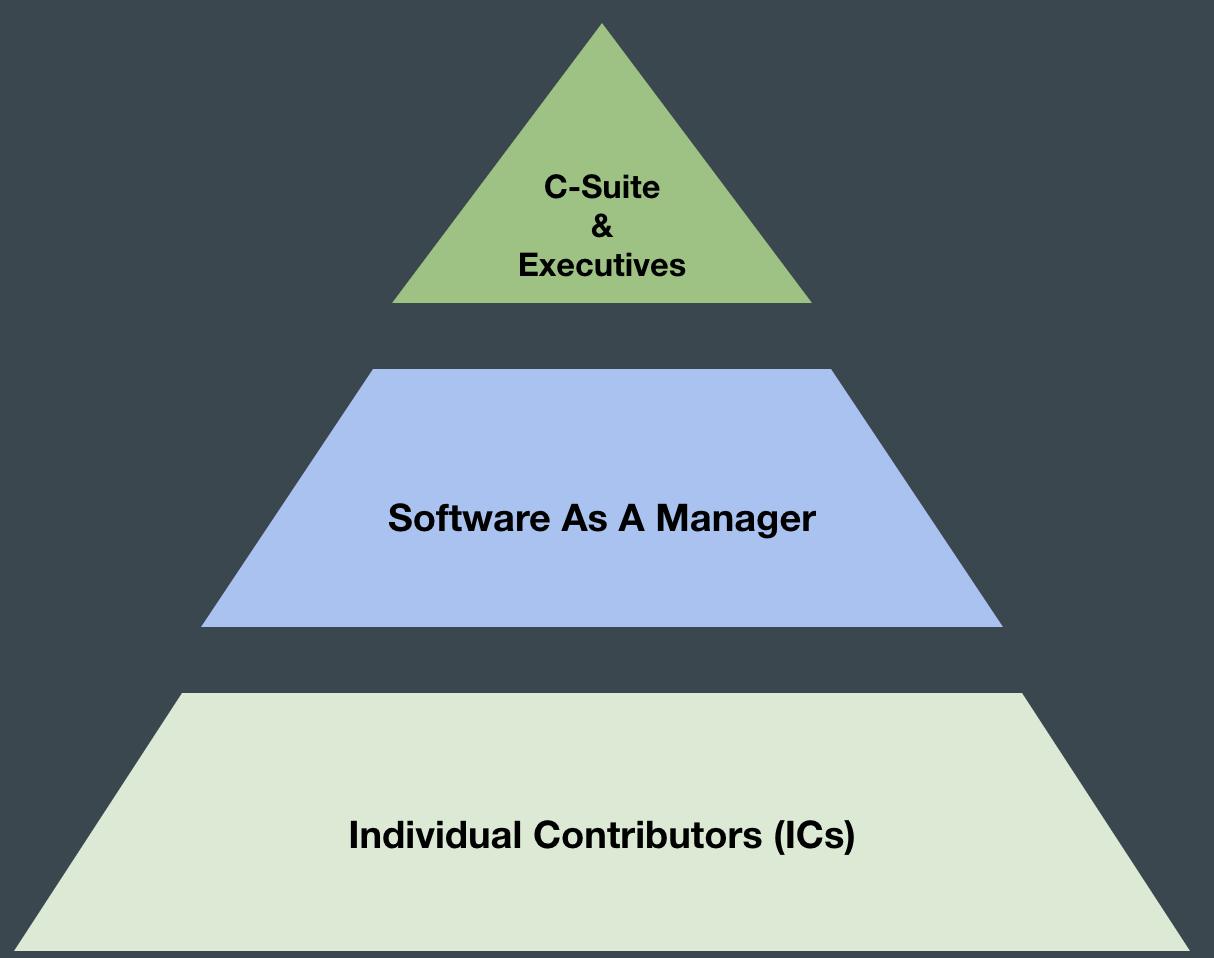
You might say, it would feel a bit weird to get encouragement and feedback from a robotic voice. I agree. I would find that weird and difficult to internalize as well.
What if the software mimicked the voice of the CEO of the company to give you impassioned and personalized feedback in a one-one session?
Imagine if every Amazon warehouse worker could get personalized attention and career advice from Jeff Bezos.
What would be the value of that?