
Do you remember the trolley problem from philosophy class?
The thought experiment goes like this:

There is a runaway trolley barreling down the railway tracks. Ahead, on the tracks, there are five people tied up and unable to move. The trolley is headed straight for them. You are standing some distance off in the train yard, next to a lever. If you pull this lever, the trolley will switch to a different set of tracks. However, you notice that there is one person on the sidetrack. You have two options:
Do nothing and allow the trolley to kill the five people on the main track.
Pull the lever, diverting the trolley onto the side track where it will kill one person.Which is the more ethical option? Or, more simply: What is the right thing to do?
The coronavirus is posing a similar challenge for us currently.
The mortality rate of the virus is relatively low (see chart below). And that’s good. If you get the virus you have a pretty high survival rate. However, at an average mortality rate of ~2%, it is still orders of magnitude higher than the Flu and creates its own set of challenging in preventing the virus from spreading.
Here is the CDC resource on the basic of the disease
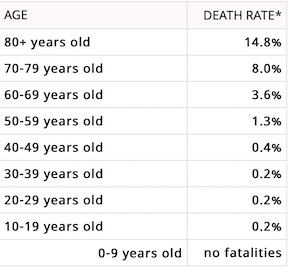
We do not have a clear understanding of how many have been affected by the virus. The mortality rate is a moot point if the denominator is higher than our current estimates. If you get the virus and you experience flu-like symptoms and recover, will you be counted in the data? Probably not. Especially not, if you are have isolated yourself as many around the world have started doing.
So how does the trolley problem factor in here?
Well, the current population of the world is ~7.5 Billion. If we assume a 2% mortality and CV manages to spread throughout the world and all the unaffected ares (in the same manner as the Flu does), then we are talking about losing approximately 150 Million individuals.
Now, the mortality rate is likely to drop as the number of individuals infected with virus increases. But even at 20 Million to 100 Million deaths, that would be a cataclysmic event in human history.
An absolutely frightening thought that I pray does not unfold.
(And for context, the Spanish Flu of 1918 infected ~500 Million people and had the death toll of around 50M to 100M people.)
How much are we willing to impose on the 7.5 Billion people to prevent the catastrophe of losing ~100 M people?
If we just let CV run its course, it could potentially be the most devastating event of the past century. But if we all just stay home and shut everything down for a few months or years we might be able to mitigate the impact. But, what is the potential impact on all our lives of taking such drastic measures?
Over the past few decades, we have lifted billions out of poverty. And our economies are more intertwined now than ever before. US companies rely on global supply chains and have benefited from the rise of consumers with significant disposable income around the world.
What would be the impact on the economy of decreased consumption and production? Of decreased economy activity? Of slower economic growth? Of slower distribution of critical medications, resources, food, water around the world? Of a sharp rise in unemployment?
One of my favorite movies is The Big Short, and there is a powerful scene in the movie where Brad Pitt’s character scolds two young bankers for celebrating their bet agains the US Economy.
“…which means if we are right, people lose homes, people lose jobs, people lose retirement savings, people lose pensions … every 1% the unemployment rate goes up 40,000 people die…”
All of this also depends on how quickly we are able to develop a vaccine. The range of estimated out there say that it may take anywhere from 3 weeks to 2 years. If it’s 3 weeks to even a few months, then it probably makes sense to shut everything down. But what if it takes 2 years or more… what then?
CV has the potential to be the nastiest version of the trolley problem ever. And there are no right answers. Just devastating tradeoffs…
Here is a link to the CDC website for virus prevention measures.
Stay safe everyone!